Backstage with Alan Mingo Jr. for 'The Wiz'
When Alan Mingo Jr. talks about The Wiz, he doesn’t sound like someone discussing a role. He sounds like someone describing destiny.
The veteran Broadway performer — whose résumé includes playing Simba in The Lion King, Donkey in Shrek the Musical, and Sebastian in The Little Mermaid — says his journey into acting began with a childhood viewing of The Wiz.
“I actually became an actor because of watching The Wiz as a kid,” Mingo recalled. “I was obsessed with the music and the dancing.”

Alan Mingo Jr as The Wiz in the North American Tour of THE WIZ.. Photo by Jeremy Daniel
For generations of Black audiences, The Wiz has occupied a unique cultural space: equal parts beloved classic, communal memory, and childhood nightmare fuel. Mention the subway scene, the Funky Monkeys, or those terrifying living puppets, and Black millennials everywhere instinctively shudder. Mingo laughed knowingly when the topic came up in our conversation.
“There were certain parts that were scary,” he admits. “My brother hated the Funky Monkeys. He hated the subway scene. It didn't quite hit me the same way because I was so excited about the songs. And I love Diana Ross and Michael Jackson as artists — and you're getting to see them live in person. And of course Richard Pryor was just hilarious. So for me, I was seeing people I kind of recognized and ‘oh my God, they're doing a musical.’”
Now, decades later, Mingo is reprising his role as the mysterious titular character in The Wiz, running May 12–17 as part of the Broadway in Austin 2025-26 season. But this production isn’t simply reviving the past. According to Mingo, it’s rebuilding the legacy of The Wiz itself — and that journey has been far more complicated than audiences may realize.
Many fans — especially Black audiences who grew up watching Diana Ross and Michael Jackson — may not realize the stage production actually came before the film adaptation.
“Most of our culture who don't go to the theater saw the movie first. It wasn't until college that someone told me, ‘oh no, the movie came second. The real version is the Broadway version,’ Mingo explained. “The movie was set in Harlem. The Broadway version was set in Kansas, just like The Wizard of Oz. So they took licensing with the movie. So people who were of that Motown era, who actually managed to get a ticket to go to the show — they know a different Wiz and they understand when they see the movie that it's different.”
That distinction became the central challenge of the revival.
Rather than choosing between the beloved Broadway production and the iconic Motown film version, the creative team decided to blend them together.
“We combined them so that we wouldn't disappoint those who were the purest in theater, who saw it with Stephanie Mills. There are thousands of people who know that version and love that version,” Mingo elaborated. “Yet those who are not theater goers know the movie version. So we combined the two — a lot of the iconic moments in the movie, we put back into this version. But I would never say that this is the movie version because, quite frankly, the movie version doesn't work on stage.”
The result is a production that honors both worlds simultaneously.
Michael Jackson fans will be relieved to know the production includes “You Can’t Win,” the legendary Scarecrow number made famous in the film. Meanwhile, longtime theater fans will still recognize the heart and structure of the original stage musical. But visually, this new Wiz is doing something entirely its own.
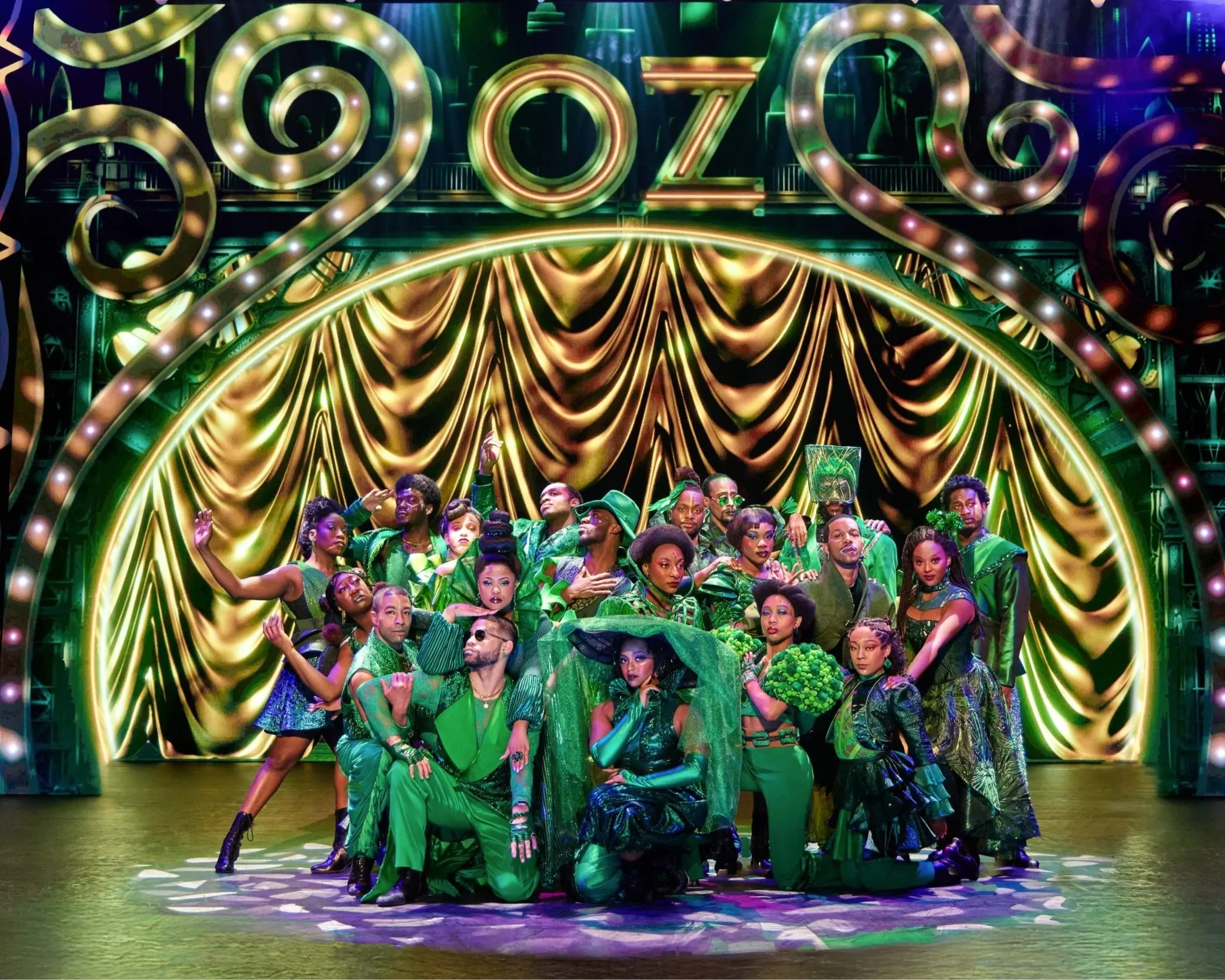
With Hannah Beachler — the Oscar-winning production designer behind Black Panther, making her the first African American to win an Academy Award for Best Production Design — helping shape the show’s aesthetic, the production leans heavily into Black futurism and fantasy rather than literal recreations of Harlem streets or subway tunnels.
“It’s more escapism,” Mingo says. “Black futurism rather than being so literal.”
Mingo’s interpretation of The Wiz may be one of the most fascinating creative choices in the production. Instead of modeling his performance after predecessors like Richard Pryor or André De Shields, Mingo created something entirely unexpected: a Wiz “more like Willy Wonka meets Samuel L. Jackson.”
“The first day of rehearsal, they said, ‘have you read the new script,’ and I was like, ‘what are you talking about? I know there's two different versions. I know both of the versions because I played them both in my career before’ and they're like, ‘go home and read it.’ I went home and read it and I had my first nervous breakdown because it was so different. This is a classic for its 50th anniversary. How dare you,” he recalled.
“The blessing in disguise was that now I was no longer tied to the same words, neither Richard Pryor or Andre DeShields who did it on Broadway. I was now forced to make my own version. But, you know, you can't unlearn or unknow what you know. So I knew the legends whose shoulders I was standing on, but now I was able to put my own stamp on it because I'm not even saying the same words. I don't have to spin it the same way they do. I now get to create the feeling that they had or they gave me when I saw them as The Wiz and now recreate it.”

Cal Mitchell as The Lion, Elijah Ahmad Lewis as The Scarecrow, D. Jerome as The Tinman, Phoenix Assata LaFreniere as Dorothy and Alan Mingo, Jr. as The Wiz. Photo by Jeremy Daniel
Oddly enough, it makes perfect sense when he explains it.
“You gotta love to hate him and hate to love him,” Mingo says. “Samuel L. Jackson can play the worst person imaginable and you’re still laughing every time he appears on screen.”
As for Willy Wonka?
“He was eccentric. He was off. And no parents had a problem with him being crazy, and they let the kids just go into the factory with him. No one had a problem with his idiosyncrasies.”
That duality became the foundation for Mingo’s Wiz: charismatic, chaotic, funny, mysterious, and impossible to fully trust.
Throughout the conversation, Mingo repeatedly returned to one central idea: Black joy. Not trauma. Not suffering. Not survival. Joy. In an entertainment landscape where Black stories are often rooted in pain, Mingo says The Wiz offers something radically different.
“This show is unapologetically Black,” he reflected. “But it’s Black joy. We’re not on plantations. We’re not being whipped. We’re not second-class citizens. It’s escapism. We don’t get many pieces like this.”
For Mingo, one of the most powerful parts of performing The Wiz isn’t even what happens on stage — it’s what happens in the audience. He described watching predominantly white theatergoers slowly loosen up in real time as gospel vocals shake the room and Black audiences respond instinctively with shouts, applause, laughter, and call-and-response reactions.
“They begin to understand us differently,” he explained. “Not from afar anymore. They’re inside the experience.”
What ultimately emerged from speaking with Mingo is the understanding that this production is not simply revisiting a classic — it’s trying to secure its future. The creative team has updated outdated slang, modernized orchestrations, tightened pacing for contemporary audiences, and carefully balanced reverence for the original with accessibility for younger viewers discovering The Wiz for the first time.
“This version is meant to live another fifty years,” Mingo says.
And if the energy surrounding the production is any indication, it just might.
For audiences in Austin, this week offers more than a chance to revisit a cultural touchstone. It’s an opportunity to witness a Black classic evolving in real time — without losing the soul that made generations fall in love with it in the first place.
Tickets start at $42. Available at TexasPerformingArts.org and BroadwayinAustin.com, by phone at (512) 471-1444, or from the Texas Performing Arts ticket office at Bass Concert Hall.

Nick Bailey is a forward thinking journalist with a well-rounded skill set unafraid to take on topics head on. He now resides in Austin, TX and continues to create content on a daily basis.