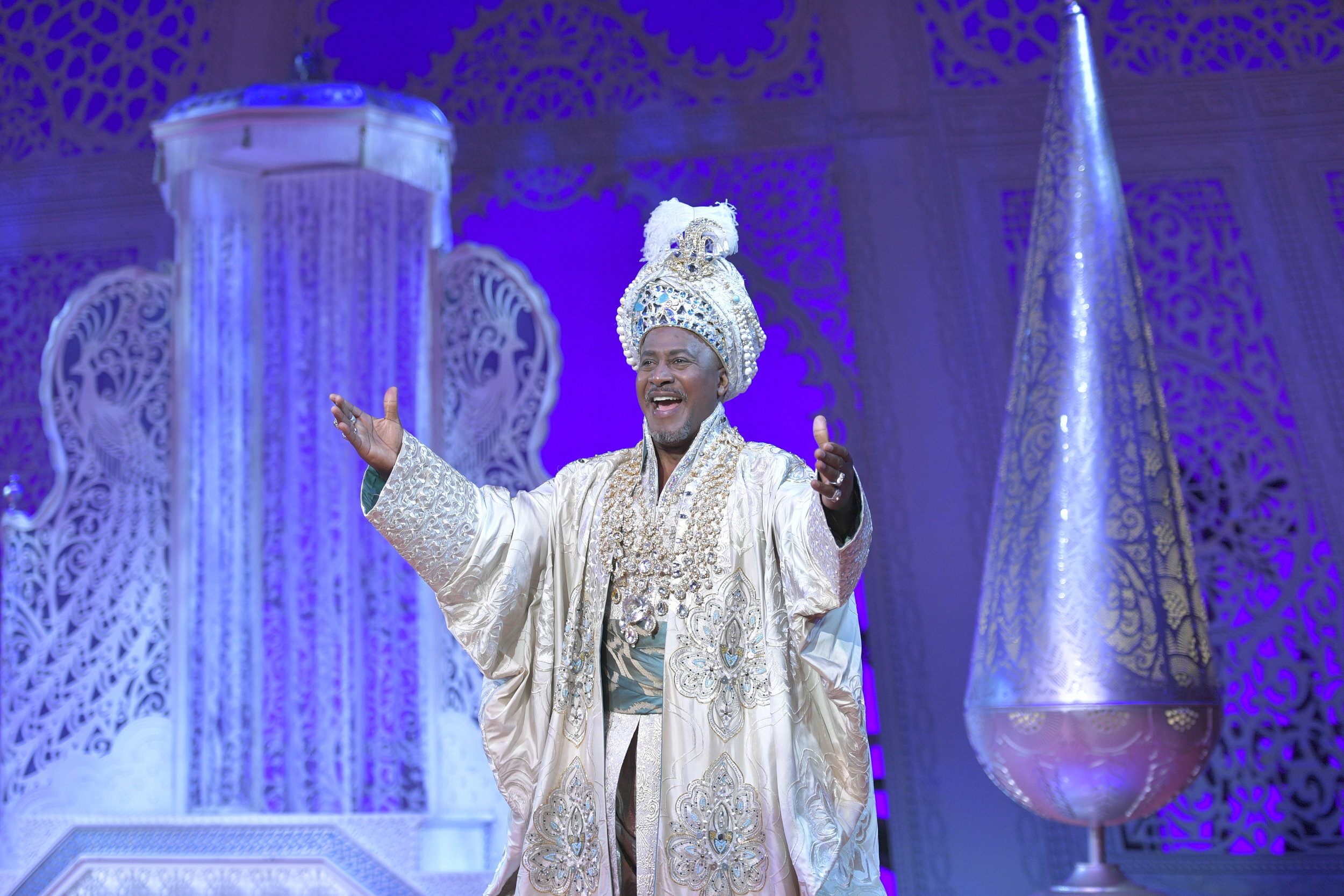
Marc Pouhé Returns to ‘Macbeth’ — This Time, on His Own Terms

When Marc Pouhé first played Macbeth with Austin Shakespeare in 2008, he was a young actor stepping into uncharted territory—both personally and historically. Black actors had rarely been invited to occupy Shakespeare’s psychological center without being filtered through centuries of expectation. Now, nearly two decades later, Pouhé is reprising the role for a third time, and this Macbeth feels less like a revival and more like a reckoning.
Running through March 1, 2026 at the Rollins Theatre inside the Long Center for the Performing Arts, this production reframes Shakespeare’s blood-soaked tragedy through a contemporary Pan-African lens — one that Pouhé himself proposed.
This “Macbeth” is set in Africa — not a single nation, but a deliberately “nondescript” landscape shaped by shared histories of colonialism, resistance, and contested power. Pouhé drew inspiration from modern political figures like Ibrahim Traoré, whose leadership is viewed simultaneously as liberation and tyranny, depending on who’s telling the story — that tension is the point.
By refusing to anchor the production to one country, Pouhé and director Ann Ciccolella aim to show how Shakespeare’s exploration of ambition transcends borders. The approach echoes earlier global reinterpretations, such as “Throne of Blood,” Akira Kurosawa’s samurai adaptation of “Macbeth.” The message is clear: these stories don’t belong to one culture — they belong to humanity.
Pouhé’s journey with Macbeth spans three eras of his own life. In 2008, his portrayal leaned on physical dominance — strength, intimidation, and kinetic energy. By 2016, following his first kidney transplant, that physicality gave way to psychology. Macbeth became a calculating politician — decisive, violent, but strategic. Now, in 2026, Pouhé’s approach is quieter, deeper, and far more dangerous. Eighteen years of life experience — and survival — have changed how he handles Shakespeare’s language. Instead of treating the text like sacred poetry, he breaks it down line by line, translating centuries-old English into lived intention.
The result is a Macbeth who feels startlingly human: relaxed in his power, confident in his choices, and terrifying in his certainty.
Ask audiences whether Macbeth is a victim of fate or the architect of his own destruction, and you’ll get endless debate. Pouhé lands somewhere in the middle. The witches may predict the future, but Macbeth chooses how violently — and how far — he goes to secure it.
“That depends on your assumption of the powers of the witches prediction, right,” Pouhé said with a laugh. “Macbeth has a line at the very beginning when he's first talking to the witches, ‘If chance will have me king, why, chance may crown me, without my stir,’ meaning, if this state is going to make me king, then it will happen no matter what I do. If I don't do anything, I'll somehow become king. It's almost like when people make a deal with the devil. The devil will promise you something and you'll get it, but the things you might do to get it, or the things that you actually see when you finally do get it… the cost is much more than originally bargained for.”
What resonates most for Pouhé now is Macbeth’s inability to stop. Even after achieving the crown, he cannot rest. Power without safety is hollow, and that fear drives him toward authoritarian extremes. It’s a pattern Pouhé sees repeating itself throughout history — and across today’s headlines. That’s where this production quietly hums with urgency. Though set in Africa, its warnings feel unmistakably domestic.
Audiences can expect a tightly paced, emotionally charged production that prioritizes clarity over spectacle—and meaning over tradition. Pouhé shares the stage with longtime collaborator Helen Marino as Lady Macbeth, alongside a cast that blends Austin Shakespeare veterans with dynamic new voices.
“People don’t come to see perfect performances. They come to see choices,” he explained. “They see you actively living in that space. Even if it's a surprising choice.”
And Pouhé is making bold ones. This isn’t just a revival. It’s an evolution — of a role, of an artist, and of what classical theater can say in a fractured world. Pouhé’s Macbeth is not a monster from the past; he’s a mirror held up to the present.

Nick Bailey is a forward thinking journalist with a well-rounded skill set unafraid to take on topics head on. He now resides in Austin, TX and continues to create content on a daily basis.